
After Amen, Move
Prayer can give us courage, but the future we want still asks us to participate.

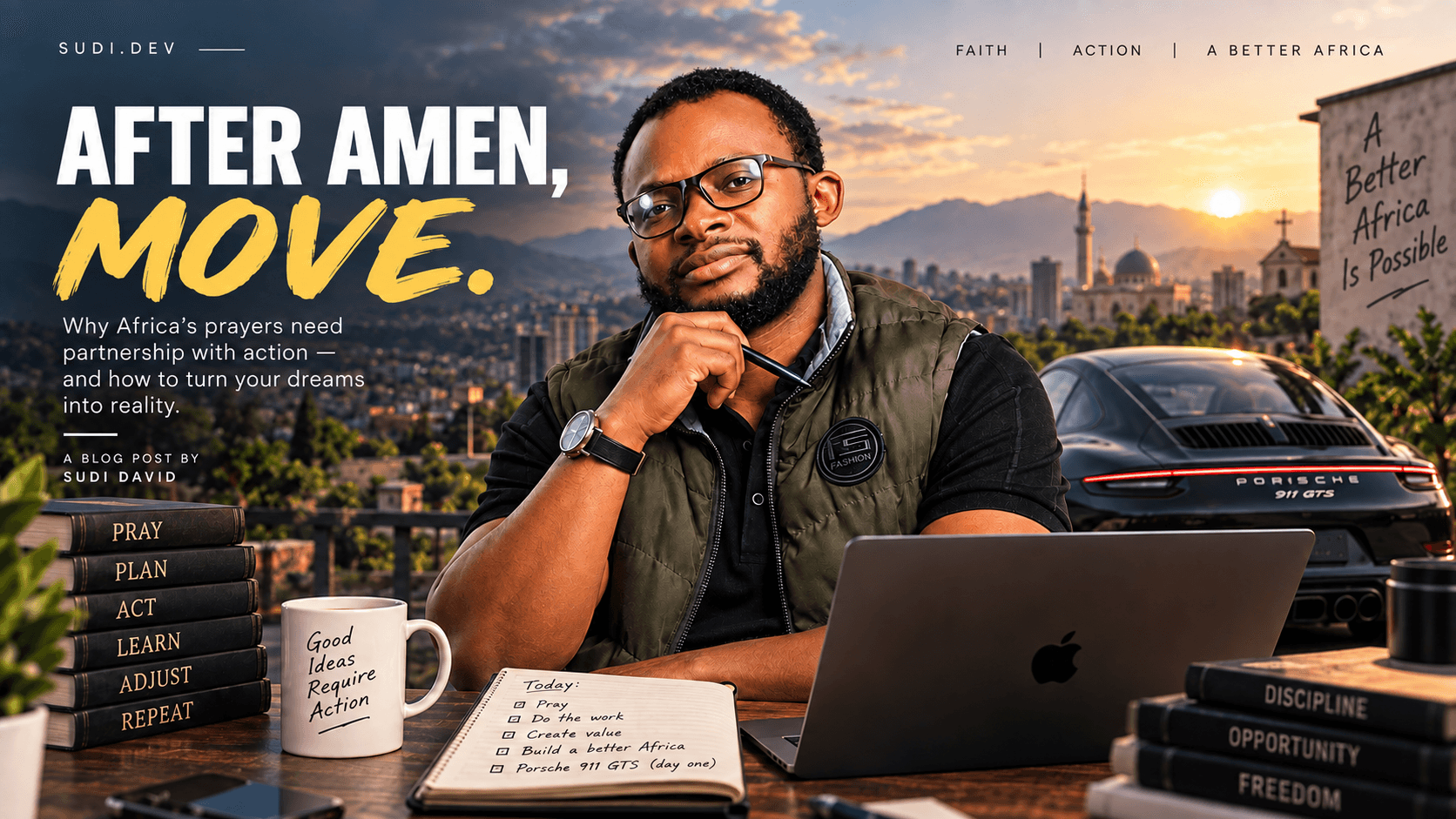
Africa might be one of the most prayerful places on Earth. We pray for jobs, businesses, better governments, prosperity, healing, opportunities, protection, and development. Churches fill up, mosques fill up, prayer meetings are everywhere, and whenever life becomes difficult, one of our most natural responses is to turn toward God.
There is nothing wrong with that. I am not writing this to tell anyone to stop praying. I pray too, and I believe there are moments when prayer gives us the strength, hope, patience, and clarity necessary to continue. But there is a question that has been sitting in my mind for some time: What if sometimes we are praying for things that require us to act?
It is difficult not to notice the contradiction. We are an incredibly prayerful continent, yet we remain a continent struggling with enormous poverty, unemployment, corruption, weak institutions, inadequate infrastructure, and millions of talented young people who cannot find meaningful opportunities. Of course, it would be intellectually lazy to say that Africa's problems exist because Africans pray instead of working. Our situation has been shaped by history, colonialism, wars, exploitation, leadership failures, global economic structures, corruption, education systems, access to capital, geography, and many other forces. Some problems are far bigger than any individual.
But acknowledging all of that should not prevent us from asking a much more personal question: What am I doing with the part of reality that is actually within my control?
I can pray for an opportunity, but if the opportunity appears and I am unprepared for it, what exactly was I expecting prayer to do? I can pray for a successful business, but at some point I have to build something, talk to customers, make mistakes, sell, learn, fail, adjust, and try again. I can pray for financial freedom, but eventually I must understand money, create value, save, invest, or build something that produces income. Prayer might change my internal state, but there are parts of the external world that still require my participation.
And this brings me to something far less spiritual: I want a Porsche 911 GTS. 😂
I know, I know. We just went from Africa, poverty, prayer, and human responsibility to a Porsche. But stay with me because this ridiculous example actually explains what I mean.
Do I need a Porsche 911 GTS? Absolutely not. There is probably some vanity involved in wanting a machine that expensive, and I am perfectly comfortable admitting that. But strangely enough, I don't particularly want it so that strangers can see me driving around and think I have made it. I want to experience it. I want to sit inside it, hear that engine behind me, feel what the engineers who built it intended the driver to feel, and probably smile like an idiot while driving it. 😂 I want that experience for myself.
Now imagine that every morning I wake up and pray for this Porsche. I could become extremely specific with God: Please, 911 GTS. Don't accidentally send me another model. You know exactly what I asked for. 😂 I could pray faithfully for ten years, but eventually there is an economic reality waiting for me outside my prayer room. That car represents a certain amount of value, and if I want to acquire it responsibly, I need to create enough value in the world to receive something equivalent in return.
That realization changes the question. Instead of asking, How badly do I want a Porsche? I should ask, What can I create that is valuable enough to eventually make a Porsche affordable to me?
Maybe I build software that solves expensive problems. Maybe I build companies. Maybe I create products that thousands of people find useful. Maybe I invest. Maybe I provide a service so valuable that people willingly exchange their money for it. Whatever path I choose, something has to happen between the dream and the Porsche, and that something is action.
The same principle applies to things far more important than cars. There is always a gap between what we desire and what currently exists, and wishing does not automatically close that gap. Prayer can give us courage to cross it. Planning can help us understand the terrain. But eventually our feet have to move.
The Beautiful Trap of Planning
Prayer is not the only place where we can accidentally hide from action. Planning can become an even more sophisticated hiding place because planning feels remarkably similar to progress.
You can spend an entire weekend designing your future. You create goals, roadmaps, milestones, schedules, Notion pages, spreadsheets, vision boards, quarterly objectives, morning routines, and beautifully organized lists. At the end of it, you feel incredible. You feel like you are finally on top of your game.
There is only one small problem: reality hasn't participated in your plan yet.
This is something software engineering has taught me repeatedly. You can design an architecture on a whiteboard and convince yourself that you have thought about everything. The components look beautiful, the arrows make sense, the responsibilities are perfectly separated, and everybody in the room nods. Then you deploy the thing into production and reality starts laughing. 😂 Real users behave differently from what you imagined. Traffic patterns surprise you. An integration fails in a way nobody anticipated. Something you considered insignificant becomes the biggest bottleneck in the system.
The architecture meeting wasn't useless. Planning matters. But production contains information that the whiteboard simply cannot give you.
Life works in much the same way.
When you plan, you are working primarily with what you already know. You can make assumptions about customers, careers, relationships, businesses, money, or yourself, but there are things you cannot discover until you collide with reality. Action introduces you to information that planning could never have given you.
This is why I am becoming increasingly attracted to a very simple mental model:
Think enough → Act → Learn → Adjust → Act again.
The important words are think enough. I am not arguing for stupidity disguised as courage. There are decisions where careful planning is absolutely necessary, especially when the consequences are difficult or impossible to reverse. But many of the things we endlessly plan are reversible. We could simply begin, observe what happens, learn from it, and make the next decision with better information.
You build the product and nobody buys it. That hurts, but now you know something that six months of planning might never have revealed. You apply for jobs and get rejected. Again, painful, but now reality has given you data. You launch the business and customers use your product completely differently from what you imagined. Excellent. Your assumptions have been corrected.
Action is not merely the execution of a plan. Action is a method of acquiring knowledge.
Faith Should Produce Movement
Perhaps the real mistake is treating faith and action as opposites. I don't think they are.
Pray for wisdom, then make a decision. Pray for an opportunity, then prepare yourself so that you can recognize it when it arrives. Pray for strength, then attempt something that requires strength. Pray for a better Africa, then ask yourself what tiny part of that enormous problem you are capable of touching.
Maybe you employ one person. Maybe you teach someone something that changes their career. Maybe you build a company that treats its employees properly. Maybe you write software that makes an African business more efficient. Maybe you grow food, improve a supply chain, finance a farmer, mentor a student, create a product, build infrastructure, or simply run one organization with integrity.
None of these actions will magically solve Africa's problems. No single entrepreneur, politician, engineer, farmer, teacher, or religious leader can do that. But development itself is ultimately the accumulation of millions of human actions. Roads have to be built. Businesses have to operate. Children have to be educated. Software has to be written. Farms have to produce. Institutions have to function. Capital has to be deployed. People have to organize themselves and actually do things.
So perhaps there is a sentence worth remembering whenever we finish asking God for the future we want:
After Amen, move.
Not because prayer is meaningless, but because perhaps the strength, intelligence, opportunities, relationships, ideas, hands, and feet we are waiting for God to send are already part of the answer.
Pray. Think. Plan enough to know your direction. Then enter reality and allow reality to teach you what your plan couldn't.
Think enough → Act → Learn → Adjust → Act again.
And as for that Porsche 911 GTS, maybe I will get it and maybe I won't. But I would rather spend my life becoming someone capable of creating enough value to make that purchase a choice than spend my life merely dreaming about owning one.
Although, God willing, I'm still getting that damn Porsche. 😂
Amen. Now, back to work.

Software engineer specializing in DevOps and cloud systems for fintech, lending, agriculture and school administration.
Comments
Signed in with GitHub. Comments live in this site's Discussions, so you can reply from there too.
Related Articles
All articlesMaybe Love Is the Now
I used to think love was the time you give someone. Then I started wondering whether time is even the thing we actually hand over.
Observability 101: Stop Debugging in the Dark
What observability actually means, and how traces, metrics and logs fit together. Part one of two — the concepts before the instrumentation.