
Attention Is All You Need
AI gives clear answers to clear prompts. Life works the same way, and Jesus talked about asking long before any computer did.

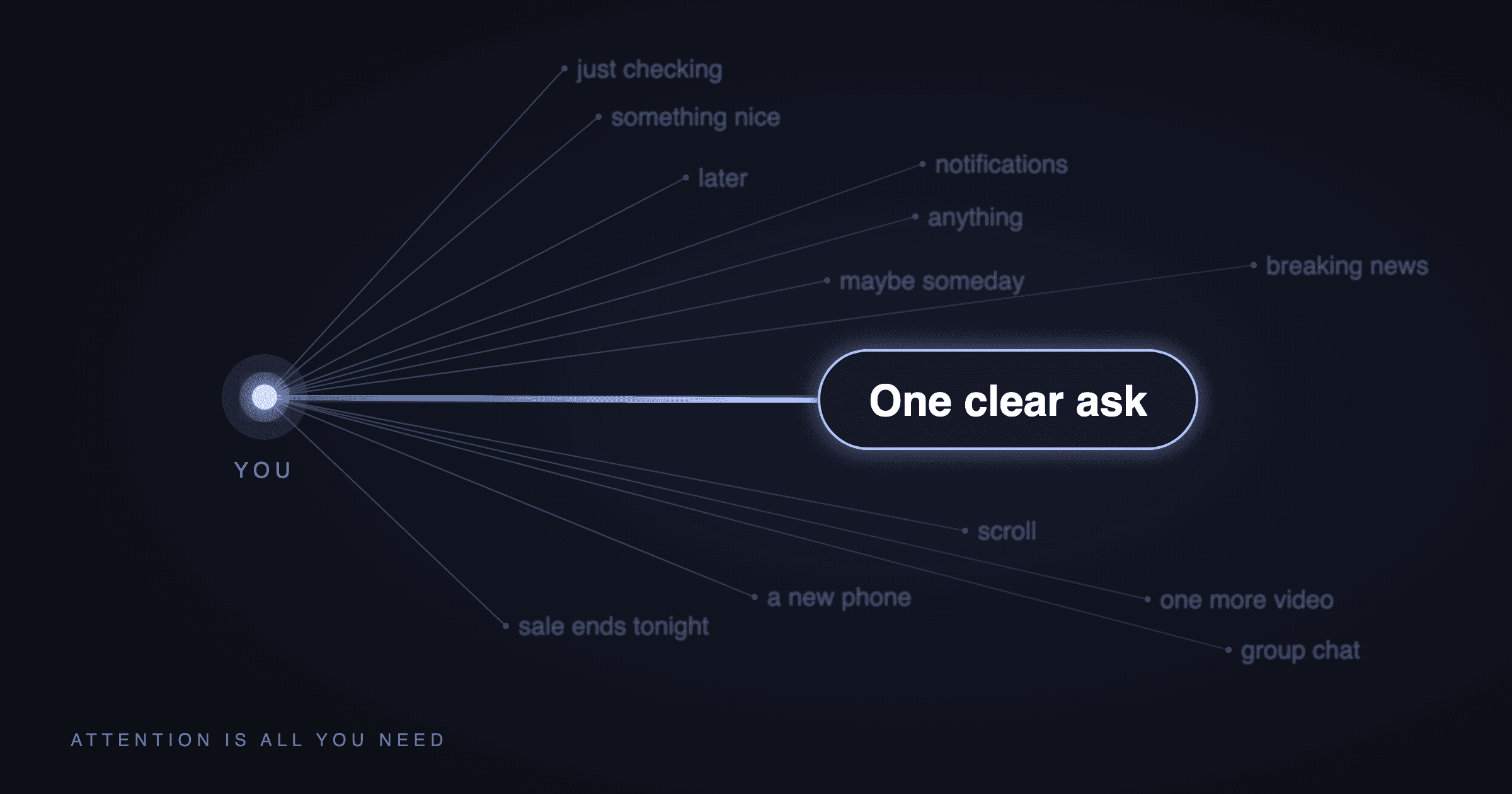
If you use AI every day like I do, you have probably been doing it wrong without knowing it. When you type "help me with dinner," you get back twenty recipes, and half of them need an oven you do not have. 😂 When you type "I have rice, two eggs, some tomatoes, and twenty minutes, what can I cook for two people?" you get a dinner you can make tonight.
Same AI. Same day. Different input.
People in my line of work have an old saying for this. Garbage in, garbage out. And the more I think about why AI works this way, the more I believe it has something to teach us about our own lives.
What the machine actually does
In 2017, a group of researchers, most of them at Google, published a paper called "Attention Is All You Need". The title sounds more like a self-help book than computer science. That paper introduced the Transformer. Yes, the T in ChatGPT.
Attention, in simple words, is how the model decides which of your words matter. For every word it writes back, it looks at everything you gave it and weighs it. A clear request gives it specific things to hold on to. A vague request gives it vague things, and it does its best with them. The model can only pay attention to what you put in front of it.
Now look at us.
Where did our attention go?
You pick up your phone to check the time. Forty minutes later you are watching a man in another country cook rice next to a river, and you still do not know what time it is. 😂
We all know this story because we all live it. Notifications, group chats, videos, news, and then more videos. Every app on your phone is built to take your attention, and attention is exactly what meaningful work needs. The business you want to build, the skill you want to learn, the family you want to show up for. None of it happens with a scattered mind.
AI does not stop halfway through your question to check its phone. 😂 It takes what you give it and points all of it at your request. I think we can learn that from a machine.
Ask, and be clear about it
Jesus talked about asking long before any computer did. In the King James Version of Matthew 7:7, he says "Ask, and it shall be given you; seek, and ye shall find; knock, and it shall be opened unto you."
Then read the next two verses. "Or what man is there of you, whom if his son ask bread, will he give him a stone? Or if he ask a fish, will he give him a serpent?" The son does not say "Daddy, give me something." He asks for bread. He asks for fish. He knows what he wants.
My reading of it is simple. If you ask for something you are not sure about, you will receive something you are not sure about.
Think about the barber. You sit down and say "just do something nice." 😂 Twenty minutes later you walk out with a haircut you did not want, because you never said what you wanted. That is not the barber's fault. That was a bad prompt.
Most of us talk to life the way we talk to that barber. "I want to be successful." "I want more money." "I want to be happy." Those are the "help me with dinner" prompts of life, and life answers them the same way AI does, with something generic.
If you have read After Amen, Move, you already know about my Porsche. 😂 I do not pray for "a nice car." I say 911 GTS. And because I know what I want, I also know how much value I need to create to get it. Being clear about what I want has worked for me more than anything else, and that is why I am writing this.
Be intentional about it
A clear prompt is only half of it. The other half is being intentional, which means you choose on purpose instead of letting the day choose for you.
Most of what fills our days was never chosen. The phone buzzes, so we pick it up. Someone sends a video, so we watch it. A friend shows us their new phone, and suddenly we need a new phone too. 😂 None of that was a decision. It just happened to us.
Being intentional means asking one question before you give anything your time, your money, or your yes: is this part of what I asked for? That goes for the meeting, the purchase, the scroll, and the side project. If it moves you toward the thing you want, give it your full attention. If it does not, you are allowed to say no.
A good prompt keeps AI from wandering. Intention does the same for you.
Write your prompt
Here is the action, and it takes five minutes.
Right now, before you go back to your phone, take a piece of paper and write down one thing you want, the way you would write a good prompt:
- What exactly do you want? Skip vague wishes like "more money" or "be healthier," because they are the "help me with dinner" kind of prompt. Write something specific, like "save $100 every month for a plot of land," "walk thirty minutes every morning," "call someone you love every Sunday," or "open your small shop by March."
- By when? Write a date.
- What does done look like? Write how you will know you got it.
Then, that same day, give it one full hour of real attention. Phone in another room. No notifications. Just you and the thing you asked for.
For the rest of the day, before you say yes to anything, ask yourself if it is part of your prompt.
AI gives everything it has to the question in front of it. Give your one hour the same treatment.
Ask clearly. Live on purpose. Pay attention.
Attention is all you need. Well, attention and a phone in another room. 😂

Software engineer specializing in DevOps and cloud systems for fintech, lending, agriculture and school administration.
Comments
Signed in with GitHub. Comments live in this site's Discussions, so you can reply from there too.